

Estimated Ship Date
General Motors’ l87 6.2-liter gasoline V8 has long been positioned as the flagship gas engine in the company’s full-size truck and SUV lineup. Found in vehicles like the Chevrolet Silverado 1500, GMC Sierra 1500, Tahoe, Yukon, and performance variants such as the Trail Boss and AT4, the engine delivers class-leading horsepower and strong towing capability. However, over the past several years, the 6.2L has also become the subject of increasing discussion surrounding reliability concerns, valvetrain noise complaints,recalls, and evolving oil recommendations.
As owner feedback, dealership service data, and independent technician observations continue to surface, the conversation around the 6.2L has shifted from isolated anecdotes to broader questions about long-term durability under real-world use, in some cases talks of class action lawsuits.
The GM 6.2L V8 is a pushrod, overhead valve engine built on the company’s small-block architecture. It incorporates modern features such as direct injection, variable valve timing, and in many applications, Dynamic Fuel Management or Active Fuel Management systems. Output varies by application, but current versions produce over 400 horsepower while maintaining competitive fuel economy for a naturally aspirated V8.
From a design standpoint, the engine is compact, torque-focused, and well suited for towing and hauling. Its architecture has proven successful across multiple GM platforms, contributing to strong sales and high consumer interest in 6.2-equipped trucks.
Despite its performance credentials, the 6.2L has drawn attention due to recurring owner reports involving valvetrain noise, oil consumption concerns, and lifter-related issues. While widespread catastrophic failures are not common, certain trends have emerged across owner forums, dealership service departments, and independent repair shops.
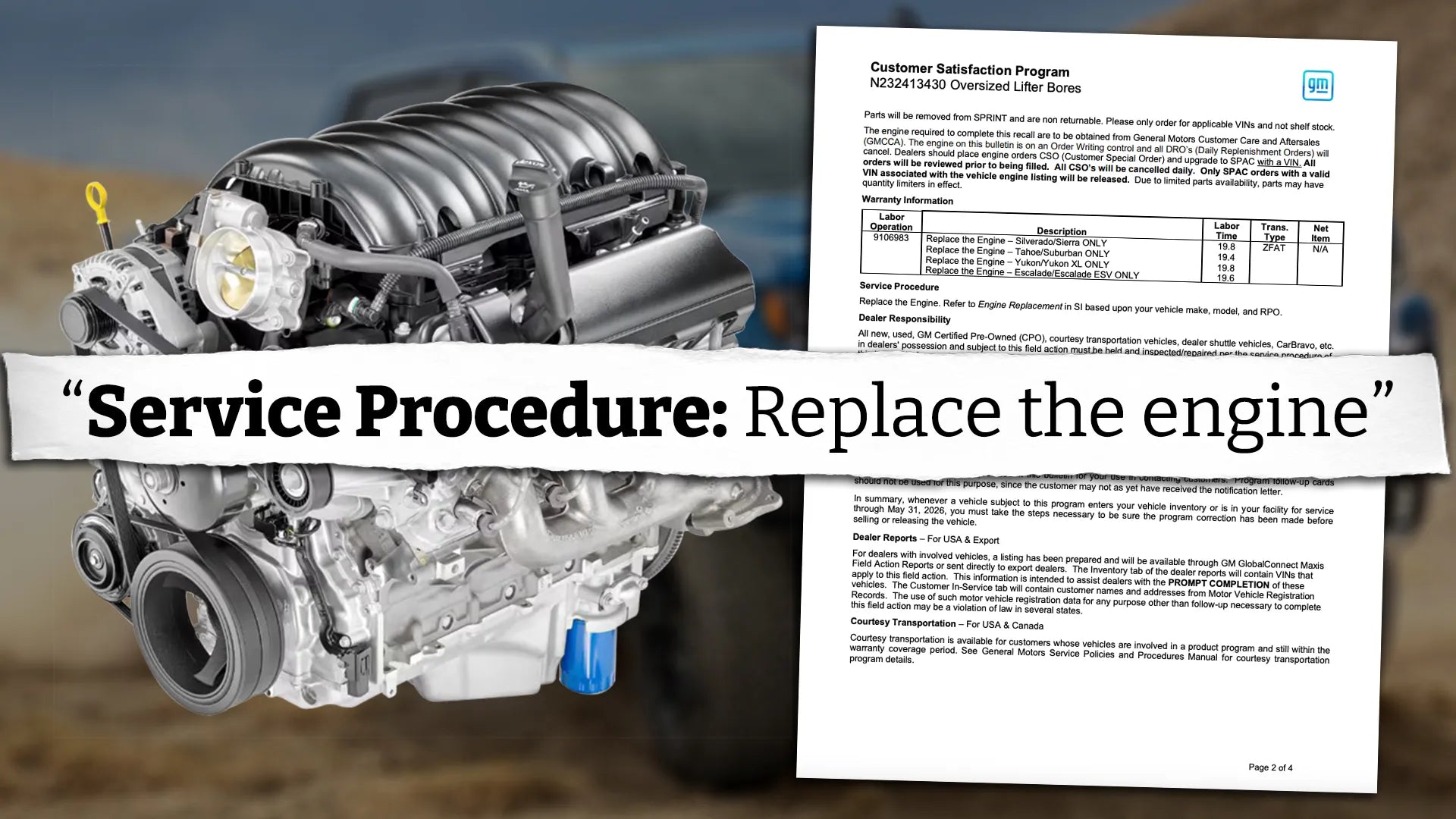
"As GM Authority reported previously, GM launched a major recall last year impacting roughly 600,000 vehicles in the U.S. equipped with the L87 engine. Affected models were built between the 2021 and 2024 model years and include the Chevy Silverado 1500, Chevy Tahoe, Chevy Suburban, GMC Sierra 1500, GMC Yukon, GMC Yukon XL, and Cadillac Escalade.
The recall addresses a supplier-related issue tied to rod bearing contamination and crankshafts that may fall out of spec. Some vehicles are eligible for a complete engine replacement, while others get a new engine oil spec. For those engines that pass inspection and are not replaced, GM previously mandated a switch from 0W-20 to 0W-40 engine oil."
- GM Authority
Technicians familiar with the platform have noted that the lifter design is highly dependent on clean oil and consistent oil pressure. When oil degrades or viscosity drops under heat and load, lifter performance can suffer, leading to noise and, in more severe cases, accelerated wear.
It is important to note that these issues are not universally experienced. Many owners report high mileage with no mechanical problems. However, the consistency of similar complaints has elevated the issue beyond isolated incidents.
At the center of the discussion is GM’s factory oil recommendation for the 6.2L engine. Historically, GM specified a relatively thin oil viscosity paired with extended oil change intervals, guided by the vehicle’s oil life monitoring system.
While these specifications meet emissions, fuel economy, and warranty requirements, critics argue they may not align with how many 6.2L-equipped trucks are actually used. Heavy towing, off-road driving, and high-load operation place significantly greater thermal and mechanical stress on engine components, particularly in the valvetrain.
In response, some dealership technicians and fleet operators have quietly adopted more conservative maintenance practices, including shorter oil change intervals and, in certain duty cycles, higher viscosity oils better suited for sustained load and temperature.
Over the last year, industry discussion has increasingly focused on oil selection as a mitigation strategy rather than a reaction to failure. While GM has not issued a blanket revision applicable to all owners, there is growing acknowledgment within service circles that oil choice should be tailored to vehicle use rather than strictly adhering to minimum factory specifications.
Key trends include:
Reduced Oil Change Intervals
Many owners servicing their vehicles at 5,000 to 7,500 miles instead of relying solely on the oil life monitor report quieter operation and fewer valvetrain complaints.
Higher Viscosity Oils for Severe Duty
In hot climates or heavy towing applications, some technicians recommend stepping up to a higher viscosity oil to maintain film strength under load, particularly during summer months.
Focus on Additive Packages
Oils with more robust detergent and anti-wear additive packages are increasingly favored to reduce deposit formation and maintain hydraulic lifter performance.
These changes are largely driven by field experience rather than official recalls or service bulletins, highlighting the gap that can exist between laboratory-based specifications and real-world vehicle usage.
From an automotive industry standpoint, the GM 6.2L V8 is not viewed as a fundamentally flawed engine....yet. Instead, it represents a modern, high-output gas engine operating closer to the limits of emissions compliance and efficiency targets than previous generations.
As with many contemporary engines, proper maintenance has become more critical, and tolerance for neglected service has decreased. Engines that once thrived on infrequent oil changes and generic fluids now require a more disciplined approach, particularly when used as intended in trucks rather than commuter vehicles.
The controversy surrounding GM’s 6.2L gas engine reflects a broader industry trend rather than a singular failure. As performance demands increase and maintenance intervals stretch, real-world usage continues to challenge factory assumptions. The growing emphasis on revised oil practices underscores how modern engines can benefit from maintenance strategies aligned with actual operating conditions.
For owners and prospective buyers, the takeaway is clear - the 6.2L remains a powerful and capable engine, but one that rewards attentive service. As oil recommendations evolve through field experience, the engine’s reputation may ultimately hinge less on design and more on how well it is maintained over time.
King of the Hammers 2026 - Another year in the books, BuiltRight in the Desert
GoPro: The history and rise of the most famous name in action cameras