

Estimated Ship Date
For a long time, the pickup segment had a simple formula. If you wanted torque and fuel efficiency, you bought a diesel. If you wanted raw horsepower, you bought a gas V8. And if you wanted something in between, well, there were always turbocharged gas engines.
But over the last few years, something quietly changed.
Seemingly as quickly as they came, diesel options started disappearing from half-ton trucks. Automakers that once pushed small diesel engines as the future of efficient trucks began walking away from them. Stricter emissions regulations, rising development costs, and the industry’s pivot toward electrification have made diesel a harder sell in the light-duty market.
Today, only one half-ton diesel remains: the GM Silverado and Sierra 1500 equipped with the Duramax 3.0L inline‑six turbo‑diesel.
And that makes it something special.
Not just because it’s good. But because it might be the last of its kind.


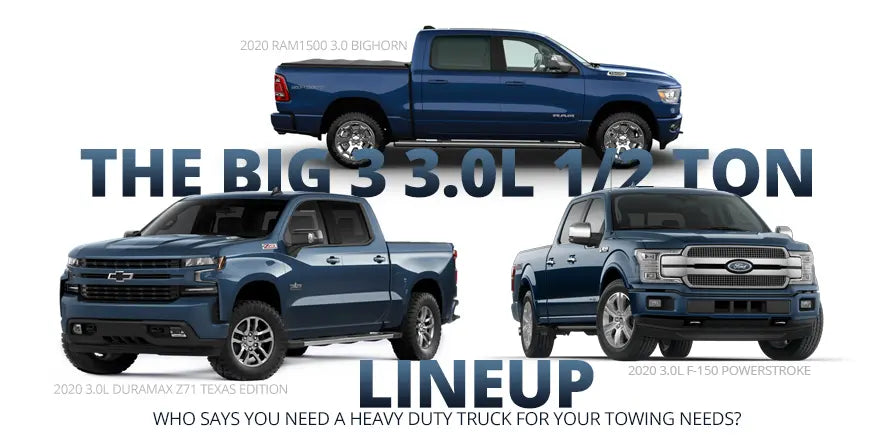
If you rewind the clock about five or six years, the half-ton diesel market actually looked pretty competitive.
You had:
The Ram 1500 with the EcoDiesel V6
The Ford F-150 with the Power Stroke 3.0L diesel
And the Chevrolet Silverado 1500 with its Duramax inline-six.
On paper, it looked like diesel was making a real comeback in the half-ton segment. These engines promised excellent towing torque and highway fuel economy that could stretch well past 30 mpg.
But it didn’t last long.
Ford pulled the diesel option from the F-150 after the 2021 model year. Ram followed shortly after, discontinuing the EcoDiesel in the 1500 lineup.
Suddenly the field was empty.
Except for Chevrolet.
And while the Silverado and Sierra 1500 still offer the Duramax engine, the reality is simple: GM is the only manufacturer still betting on diesel in a light-duty pickup.

Part of the reason the Duramax survived where others didn’t comes down to engineering.
Unlike its competitors, GM designed the engine from the ground up as a modern inline-six diesel rather than adapting an existing platform.
The latest version of the engine produces around 305 horsepower and 495 lb-ft of torque, and it delivers that torque low in the rev range where trucks actually use it. For towing, hauling, and highway cruising, that matters more than peak horsepower numbers.
But the real magic shows up at the pump.
Owners regularly report high-20s to low-30s mpg on the highway, which is remarkable for a full-size pickup. With a long-range fuel tank, trucks equipped with the Duramax can easily travel 600 miles or more between fill-ups.
For people who tow boats, travel trailers, or gear across long distances, that kind of range isn’t just convenient. It changes how you use the truck.
The engine is also incredibly smooth. Inline-six engines are naturally balanced, and the Duramax takes advantage of that. Compared to many diesel engines of the past, it feels refined and quiet, especially on the highway.
It’s not the diesel school bus experience people remember from the early 2000s. It’s something more modern.
So if the formula works so well, why did everyone else abandon it?
The answer isn’t performance.
It’s economics and regulation.
Modern diesel engines require extremely complex emissions systems. Diesel particulate filters, selective catalytic reduction, DEF injection, and advanced exhaust after-treatment systems all add cost and engineering complexity.
For heavy-duty trucks, that cost is easier to justify. Buyers expect diesels to be expensive, and they rely on them for serious towing and commercial use.
But in half-ton trucks, the math gets trickier.
Gas engines have gotten better. Turbocharged V6 engines and hybrid powertrains now deliver torque numbers that rival older diesel engines, often with lower upfront costs and fewer emissions hurdles.
At the same time, the industry is pouring billions into EV development. That leaves fewer resources to continue refining niche powertrains like small diesel engines.
The result?
Automakers started simplifying their engine lineups.
Diesel was the first thing to go.
What’s interesting is that the Duramax still fills a very real niche.
For a lot of truck owners, a half-ton diesel hits the sweet spot between capability and efficiency.
You get:
Real towing torque
Excellent highway fuel economy
Long driving range
And the drivability of a modern pickup
For people who tow boats, run long highway trips, or build overland trucks, the diesel option can make a lot of sense.
It’s also worth noting that diesel trucks tend to hold their value well. When a drivetrain option becomes rare, demand often grows in the used market. If the Silverado remains the only diesel half-ton available, that could make these trucks even more desirable in the long run.
Right now, the Duramax 3.0L inline‑six turbo‑diesel stands alone in the half-ton segment.
There are no credible rumors that Ford Motor Company or Stellantis plans to bring diesel back to the Ford F-150 or Ram 1500 anytime soon.
If anything, the industry is moving in the opposite direction. Hybrid systems and electrification are rapidly becoming the focus of light-duty trucks.
That means the Silverado’s diesel might represent the final chapter of a short but interesting era in truck history - the attempt to bring heavy-duty diesel efficiency to everyday pickups.
Whether GM keeps the engine around long term remains to be seen. But for now, if you want a diesel in a half-ton truck, there’s really only one option left.
And that makes the GMC Sierra and Chevrolet Silverado 1500 with the Duramax something of a unicorn in today’s truck market.
The half-ton diesel experiment may not have taken over the market the way some manufacturers expected, but the trucks that did exist proved something important.
There’s still a place for diesel power in light-duty pickups.
The Duramax 3.0L inline‑six turbo‑diesel shows what happens when a diesel engine is designed specifically for modern trucks: strong torque, excellent fuel economy, and a driving experience that’s far smoother and quieter than many people expect.
In an era where powertrains are rapidly changing, that makes the Silverado diesel feel like something rare.
Maybe even the last of its kind.
Brb, heading to facebook marketplace to buy one.
Theres no replacement for displacement... or is there? The State of the V-8 in Modern Trucks
Rivian R2 Enters the Market – And It’s Gunning for Gas SUVs