

Estimated Ship Date
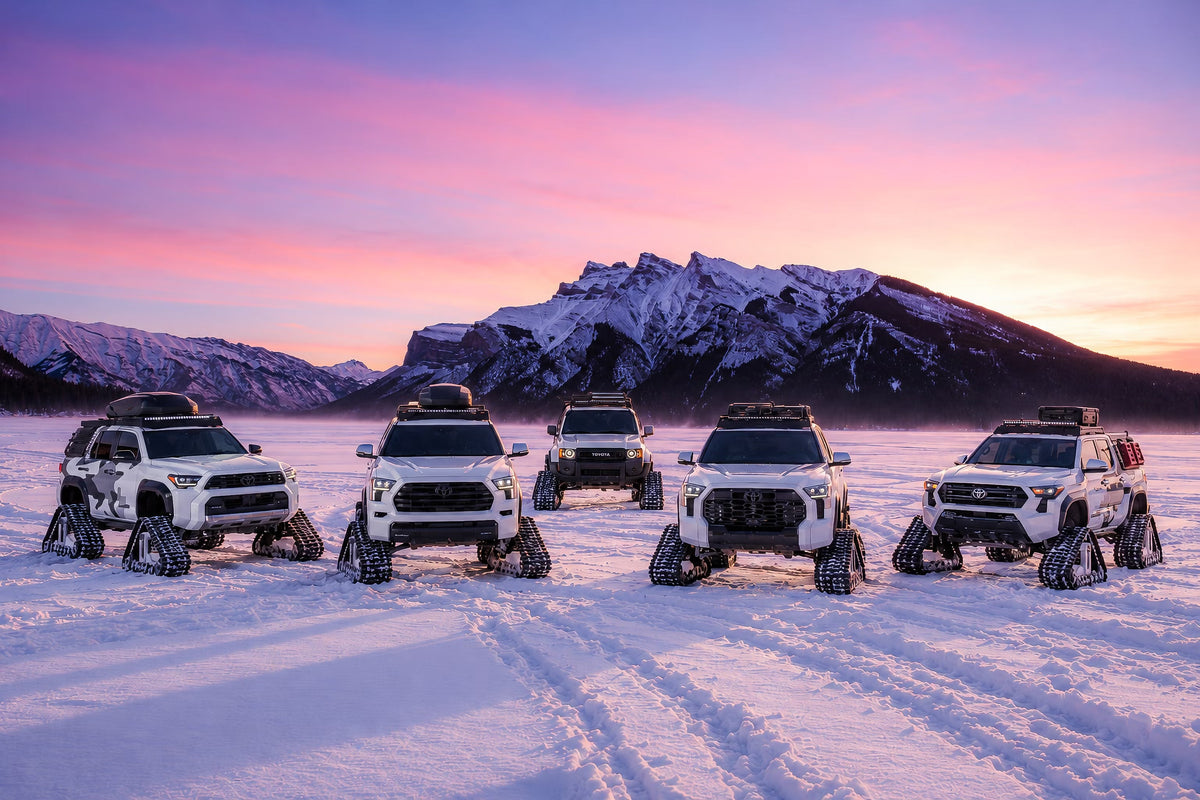
Toyota's latest SEMA builds prove that off-road adventures don't have to stop when the snow starts falling. With five tracked-out trucks and SUVs, the Snowhunter concept family takes winter exploration to a whole new level.
For most people, the arrival of winter means putting away the camping gear, parking the off-road toys, and waiting for spring to roll around again. For anyone living in the northern part of the country, though, winter is just another season to get outside. The trails might be covered, the lakes might be frozen, and the roads might be buried under a few feet of snow, but that doesn't mean the adventure has to stop.
Toyota seems to agree.
For the 2026 SEMA Show, Toyota brought an entirely different approach to its off-road lineup with the introduction of the Snowhunter concept family. Rather than building a single wild show truck, Toyota took five of its body-on-frame trucks and SUVs and reimagined them as purpose-built winter expedition vehicles. The result is a lineup that includes the Tundra, Tacoma, 4Runner, Land Cruiser, and Sequoia, all wearing custom winter camouflage and trading their conventional wheels and tires for snow tracks.
Developed with help from Toyota's CALTY Design Research team in Ann Arbor, Michigan, the Snowhunter concepts are designed around a simple idea: take the vehicles people already trust for off-road adventures and adapt them for the conditions that keep most other vehicles off the trail.
And while the snow tracks are obviously the biggest attention grabber, there's a lot more going on with these builds than simply replacing four wheels with four miniature snowmobile assemblies.
Toyota didn't limit the Snowhunter treatment to one particular vehicle or market segment. Instead, the company applied a consistent design philosophy across its entire body-on-frame truck and SUV lineup.
All five concepts share a distinctive white-and-gray Snowhunter camouflage treatment, black exterior accents, additional RIGID auxiliary lighting, and suspension lift components from Toyota Genuine Parts and TRD. The vehicles sit approximately 2.5 to 3 inches higher than their standard configurations, providing additional clearance and room for the specialized tracked drive systems.
The most obvious modification is the replacement of traditional wheels and tires with white powder-coated snow tracks. These assemblies provide a significantly larger contact area than conventional tires, distributing the vehicle's weight across a wider footprint. That additional surface area helps prevent the vehicle from sinking into deep snow and provides the traction needed to move through conditions where even a capable four-wheel-drive truck might struggle.
It's a pretty dramatic departure from the typical SEMA build. Instead of another truck with oversized tires, aftermarket bumpers, and a collection of LED light bars and.... train horns....., Toyota has essentially built five snowcats.
Of course, the Snowhunter concepts aren't intended to be production-ready vehicles. They're special project builds intended to demonstrate what's possible when Toyota's existing platforms are paired with specialized equipment and aftermarket accessories. Still, there's plenty of inspiration here for anyone who spends time exploring outside the traditional off-road season.
The largest member of the Snowhunter family might also be the most interesting from an equipment and organization standpoint.
Toyota positioned the Tundra Snowhunter as a mobile basecamp, and the modifications reflect that purpose. Rather than focusing exclusively on getting through deep snow, this build is designed to carry the equipment needed for extended trips and outdoor activities.
The centerpiece is the Toyota TrailLift Pro Rack System Concept, a modular cargo solution developed by CALTY. Mounted to a specialized modular bed cap, the system is designed to accommodate a variety of equipment and storage configurations.
One of the more interesting features is its articulating upper rack. The rack can be lowered to make loading larger equipment easier, whether that's a kayak, bicycle, canoe, or other oversized cargo. Anyone who's spent time loading equipment onto a tall truck rack knows how much of a difference a feature like this can make.
The modular bed cap also incorporates a roll-up enclosure, allowing the truck bed to remain open when carrying larger equipment or secured and enclosed when additional protection is needed. Removable side storage bins and modular MOLLE storage panels add even more flexibility.
It's a good example of how much thought can go into making a truck bed more useful. A pickup is already a pretty capable platform for hauling equipment, but the right combination of storage, mounting points, and cargo management can make it significantly more versatile.
The Tundra also receives TRD billet rear control arms designed to work with the tracked setup, along with additional lighting and exterior equipment.
For anyone building a dedicated adventure truck, the rack and bed cap combination is arguably one of the most interesting parts of the entire Snowhunter lineup. Even without the snow tracks, a system that makes it easier to configure, access, and organize truck bed cargo has plenty of real-world appeal.
While the Tundra is designed to serve as a mobile basecamp, the Tacoma Snowhunter takes a more compact approach.
The Tacoma has long been one of Toyota's most popular platforms for off-road customization, and it's easy to see why it makes sense as part of the Snowhunter family. Its smaller footprint makes it a natural fit for navigating tighter trails and wooded environments where a full-size truck might be less convenient.
The Tacoma build features a full-length bed rack with integrated MOLLE panels, additional cargo storage, an awning, recovery equipment, and dedicated bed lighting. A roof rack provides additional mounting space for equipment needed during longer trips.
The combination of modular mounting points and accessible storage is particularly useful here. When you're traveling through snow-covered terrain, keeping recovery equipment and other essentials organized and accessible becomes even more important.
It's also a setup that makes sense outside of winter. The same rack, storage, and mounting solutions could easily be used for camping, overlanding, hunting, or everyday equipment organization.
The Tacoma Snowhunter is a reminder that building a capable off-road truck doesn't necessarily mean going bigger with every component. Sometimes, having a smaller and more maneuverable platform with the right equipment is the better approach.
The 4Runner has always been one of Toyota's most recognizable off-road vehicles, making it a natural addition to the Snowhunter lineup.
Rather than turning the SUV into an elaborate cargo hauler, Toyota focused on equipment that makes sense for extended backcountry travel.
The build features Toyota Genuine rock rails, a Prinsu roof rack with accessory panels, and a Thule Pulse 2 cargo box. These additions provide additional protection and storage without fundamentally changing the vehicle's original purpose.
The roof-mounted cargo box is particularly practical for winter use. Keeping equipment outside the passenger compartment helps preserve valuable interior space while providing a dedicated location for skis, snowboards, and other outdoor equipment.
Combined with the snow tracks, suspension lift, and additional lighting, the 4Runner Snowhunter looks ready to explore places that most people would never consider driving into during the winter.
It's also one of the easier builds to imagine translating into a more conventional daily-driver setup. Rock rails, roof racks, cargo boxes, and auxiliary lighting are all accessories that can provide legitimate benefits throughout the year.
Few vehicles have the off-road reputation of the Toyota Land Cruiser, and the Snowhunter treatment gives the latest generation an entirely different personality.
The Land Cruiser Snowhunter focuses on protecting the vehicle while adding equipment for winter recreation and backcountry exploration.
Toyota equipped it with rock rails and skid plates, providing additional protection underneath the vehicle and along its sides. A Prinsu roof rack with accessory panels adds mounting options, while a Thule SnowPack ski rack provides a dedicated solution for carrying winter sports equipment.
The combination makes sense for a vehicle that already has a strong reputation for traveling into remote areas. Rather than simply adding accessories for appearance, the modifications help address some of the practical challenges associated with winter exploration.
The additional lighting is another important part of the package. During the winter months, daylight hours become increasingly limited, particularly in northern states. Having additional illumination can make a meaningful difference when navigating remote trails or setting up camp after dark.
Of all five concepts, the Land Cruiser might be the one that feels most naturally suited to the idea of a dedicated winter expedition vehicle.
Rounding out the lineup is the Sequoia, Toyota's largest SUV.
While the Tundra provides the cargo capacity of a pickup, the Sequoia offers a different combination of passenger space and enclosed storage. For families or groups traveling together, that can be a significant advantage.
Toyota equipped the Sequoia Snowhunter with a TRD front skid plate, Toyota Genuine cast aluminum running boards, a Prinsu roof rack with accessory panels, and a Thule Pulse 2 cargo box.
The front skid plate provides additional protection from ice, snow, and other debris that can be encountered when traveling through rough winter terrain. The roof rack and cargo box create additional storage capacity without taking up valuable interior space.
Like the other Snowhunter concepts, the Sequoia receives the same tracked drive system, suspension lift, and winter-inspired exterior treatment.
It's an interesting interpretation of the full-size SUV. Most people probably wouldn't consider a Sequoia their first choice for navigating deep snow-covered trails, but Toyota's build demonstrates how dramatically the right equipment can change the capabilities and intended use of an existing platform.
It's hard to look at the Snowhunter concepts without immediately focusing on the tracks. They're unusual, visually dramatic, and certainly make these vehicles stand out from the typical SEMA builds.
But the more interesting takeaway is how Toyota approached the rest of the vehicles.
Instead of treating each concept as an isolated project, the company built a family of vehicles around a common set of ideas: modular storage, accessible equipment, additional protection, improved lighting, and purpose-built accessories.
Those are the same considerations that go into building just about any capable off-road truck.
The snow tracks might be the most specialized component, but the rest of the equipment is much more familiar to anyone who has spent time modifying a truck. Roof racks, bed racks, MOLLE panels, cargo boxes, recovery equipment, auxiliary lighting, and protective components are all common parts of the aftermarket.
What's different is seeing a major manufacturer incorporate so many of these ideas into its own concept vehicles.
Toyota has also been expanding its Trailhunter offerings, demonstrating that there's a growing market for vehicles that come equipped with adventure-oriented equipment from the factory. The Snowhunter concepts take that philosophy in a more specialized direction, showing how the same basic approach can be adapted for a completely different environment.
And that's an interesting development for the aftermarket industry.
For years, building an off-road vehicle generally meant starting with a stock truck and figuring out which aftermarket components would get it where you wanted to go. Today, manufacturers are increasingly incorporating those same ideas into factory-backed accessories, special editions, and concept builds.
That doesn't mean there's any shortage of reasons to modify a vehicle yourself. If anything, it gives owners more options when deciding how they want to build their trucks.
The obvious question is whether someone could take a production Tundra, Tacoma, or 4Runner and build something similar.
The short answer is yes, at least in concept. The more practical answer depends on how far you're willing to go.
The suspension lift, auxiliary lighting, roof racks, bed racks, storage systems, and protective equipment are all familiar components within the aftermarket. Many of these modifications are available today, and they don't necessarily require an elaborate custom build.
The tracked drive systems are another story.
Replacing a vehicle's wheels and tires with tracked assemblies introduces a number of engineering considerations. Track systems change the vehicle's effective gearing, rolling resistance, contact patch, steering characteristics, and overall unsprung weight. They also place different loads on suspension components, hubs, bearings, axles, and drivetrain components.
Simply bolting a set of tracks onto a truck doesn't automatically make it suitable for extended operation in deep snow.
The vehicle's powertrain, suspension, braking system, and track assemblies all need to work together. Speed limitations, maintenance requirements, and the specific terrain the vehicle is intended to operate in also become important considerations.
That's especially true with full-size trucks like the Tundra. Moving a vehicle of that size through deep snow requires a substantial amount of power and puts considerable demands on the entire drivetrain.
For most owners, a properly equipped four-wheel-drive truck with quality winter tires will be a much more practical option. But for specialized applications, particularly in remote areas where snowmobiles and traditional snowcats are already common, tracked vehicles can offer capabilities that conventional tires simply can't match.
The Snowhunter concepts aren't necessarily a blueprint for a weekend garage project. They're more of a demonstration of what happens when you build a vehicle around a specific environment instead of trying to make one setup work everywhere.
One of the biggest takeaways from the Snowhunter lineup is that Toyota understands the appeal of customization.
The company could have shown up to SEMA with five stock trucks and SUVs, a few cosmetic accessories, and a collection of factory brochures. Instead, it brought five heavily modified concepts that demonstrate how dramatically its existing platforms can be adapted for different uses.
The involvement of companies like RIGID Industries, Prinsu, and Thule also highlights the relationship between vehicle manufacturers and the aftermarket suppliers that help turn these concepts into reality.
That's a good thing for enthusiasts.
Factory-backed accessory programs give buyers another way to personalize their vehicles, while aftermarket manufacturers continue to develop solutions for owners who want something different from what the factory offers.
And while Toyota's Snowhunter builds are obviously designed to grab attention at SEMA, some of the ideas behind them are surprisingly practical. Better cargo organization, modular mounting systems, accessible storage, and improved lighting are useful regardless of whether you're driving through a snow-covered forest or heading down the highway.
It's also a good reminder that the best vehicle builds aren't necessarily the ones with the biggest tires or the most horsepower. They're the ones that are thoughtfully designed around how the vehicle will actually be used.
Toyota's Snowhunter concepts might be a little over the top, but that's part of what makes them interesting.
Five different vehicles, five different approaches to winter exploration, and one common goal: keep going when the weather turns against you.
Whether it's the Tundra's modular bed storage system, the Tacoma's trail-focused equipment, or the Land Cruiser's combination of protection and winter recreation accessories, there's something in each build that can inspire a more practical truck project.
And for those of us who spend a good portion of the year dealing with snow, ice, and everything else winter throws our way, the idea of a purpose-built winter adventure vehicle isn't quite as ridiculous as it might sound.
You don't necessarily need a set of snow tracks to make your truck more capable. Sometimes, a few well-chosen accessories and a little thoughtful engineering are enough to make the difference between parking it for the season and finding a reason to get back outside.
Toyota's Snowhunter concepts are just a particularly entertaining example of what happens when you take that idea to the extreme.
One thing is certain: Toyota has given us a pretty good reason to look forward to the next snowstorm.

Chevy Might Finally Be Building a Raptor and TRX Competitor
Don't Wait Until It's Too Late - The BuiltRight Black Friday Sale Ends Cyber Monday